Prairie Yard & Garden
EAB and Marshall’s Plan
Season 34 Episode 13 | 28m 45sVideo has Closed Captions
Joe Zeleznik explains what emerald ash borer is, how it damages trees and how it spreads.
Joe Zeleznik, NDSU extension forester explains what emerald ash borer is, how it damages trees and how it spreads. Then, learn about what the community of Marshall is doing to lessen the borer’s effect.
Problems playing video? | Closed Captioning Feedback
Problems playing video? | Closed Captioning Feedback
Prairie Yard & Garden is a local public television program presented by Pioneer PBS
Production sponsorship is provided by ACIRA, Heartland Motor Company, Shalom Hill Farm, Friends of Prairie Yard & Garden, Minnesota Grown and viewers like you.
Support provided by:


Prairie Yard & Garden
EAB and Marshall’s Plan
Season 34 Episode 13 | 28m 45sVideo has Closed Captions
Joe Zeleznik, NDSU extension forester explains what emerald ash borer is, how it damages trees and how it spreads. Then, learn about what the community of Marshall is doing to lessen the borer’s effect.
Problems playing video? | Closed Captioning Feedback
How to Watch Prairie Yard & Garden
Prairie Yard & Garden is available to stream on pbs.org and the free PBS App, available on iPhone, Apple TV, Android TV, Android smartphones, Amazon Fire TV, Amazon Fire Tablet, Roku, Samsung Smart TV, and Vizio.

Prairie Yard & Garden Premium Gifts
Do you love gardening? Consider becoming a friend of Prairie Yard & Garden to support this show and receive gifts with your contribution. Visit the link below to do so or visit pioneer.org/donate.Providing Support for PBS.org
Learn Moreabout PBS online sponsorship- My husband, Tom is on the local city tree board.
He is very concerned about Emerald Ash borer, especially since this insect has now been found in a community less than 60 miles from where we live.
I wanted to find out more about EAB.
So I called on a friend, Joe Zeleznik, who is an extension forester to fill me in.
Then we'll travel to Marshall, Minnesota to find out what their community and all of us can do to get ready for this awful pest and help prevent its spread.
- [Announcer] Funding for Prairie yard and garden is provided by Heartland Motor Company, providing service to Minnesota and the Dakotas for over 30 years in the heart of truck country.
Heartland Motor Company, we have your best interest at heart.
Farmer's mutual telephone company and federated telephone cooperative, proud to be powering Acira.
Pioneers in bringing state-of-the-art technology to our rural communities.
Mark and Margaret, Yankel Julene in honor of Shalom Hill farm.
A nonprofit rural education retreat center in a beautiful Prairie setting near Windom, Minnesota.
And by friends of Prairie yard and garden, a community of supporters like you who engage in the long-term growth of the series.
To become a friend of Prairie yard and garden visit pioneer.org/pyg.
(soft music) - Initials have gotten to be so popular in our culture.
My kids will roll their eyes when I ask them what LOL means on my phone message.
Using initials for words is even common in the plant world.
The people in my generation will remember DED which was short for Dutch Elm Disease.
This was a terrible disease that wiped out so many of the beautiful Elms that shaded our homes and city streets.
Today, we're going to learn about EAB with Joseph Zeleznik and then find out what one city is doing to prepare for that major tree issue.
Welcome, Joe.
- Thank you Mary.
Glad to be here.
- Joe, what is EAB or what does that stand for?
- EAB is Emerald Ash borer.
It's an insect that it's killing ash trees throughout much of the Eastern US slowly working its way West.
It came to the US in the mid to late 1990s in the Detroit, Michigan area.
And from there it gradually spread and they didn't figure out it was there or what was causing problems with our Ash trees until 2002.
It damages them initially and eventually will kill them.
- [Mary] What does an Ash tree look like?
So if people have it in their yard, what can they know in order to identify it?
- Okay, well, there's two things that people should know first is that Ash is opposite and that is the branches come across opposite from each other.
You could see it on this one.
On this one you might notice there used to be a branch here, broke off.
So it's a little tricky.
So the branches come off opposite of each other, the leaves come off opposite of each other.
But the leaves are compound leaves.
This is a compound leaf not a simple leaf and a compound leaf has multiple leaflets.
And the way you tell a compound leaf versus a simple leaf is where's the bud.
The bud is at the base of the leaf overall.
Most of the things that are opposite with compound leaves will be ash.
- [Mary] What does Emerald Ash borer damage look like on their trees?
- Okay.
On the overall tree, if you're looking at the big picture it'll start with some die back from the top.
The insects like to feed near the top first and then gradually work their way down.
So the larvae of Emerald Ash borer or the little caterpillars they feed under the bark and what they do is they go back and forth, back and forth, back and forth.
Serpentine, it's clearly back and forth in their feeding as they develop.
This tree was hit by lots and lots of Emerald ash borers.
So early on in the infestation when there's just one or two in the tree, we'll see this, later on we'll see galleries, feeding galleries going everywhere.
The other thing I wanna point out is that this girdles the tree, so the top gets starved of water and nutrients from the soil so then the roots get starved of the sugar that's coming down from the leaves.
So it's kind of both the top and the bottom gets starved in different ways.
- What do the adults and also the larva look like?
- Okay, the adults are a metallic green.
I've never actually seen one.
I've seen little samples in a vile but I've never actually seen one.
Usually the metallic green insects that I see are the six spotted tiger beetle.
You might be familiar with.
Very pretty, very pretty.
And some metallic wood borers.
So I've never actually seen the adult of Emerald Ash borer.
The larvae are kind of a creamy white segmented.
They've got these bell shaped segments.
And that's one thing that's really distinct about them is that bell shape.
Because again, some of these native borers look a little bit similar.
And the other key identifier for the larvae for EAB they have these two little prongs sticking out the backside.
They're called Earl Gamefy, technically and they're only on EAB.
You don't see them on a native Ash borers that might look similar.
- How do the Emerald Ash borers travelers spread?
- You know, the adults can fly.
Generally maybe they fly about a half a mile.
They could fly up to 10 miles.
Generally it's firewood.
Firewood or pallet wood.
Sometimes if the bark is still on the wood that can cause problems, that can transport insects hundreds of miles, buy it where you burn it.
I love that phrase.
It's very simple and straightforward because even out here on the Prairie, there's enough trees that there is firewood available from local vendors.
- [Mary] So if people have Ash in their woodpile they could actually be harboring.
- They could, up to two years, I believe is how long it could take the insect to develop under the bark.
The other part is if it was a piece of firewood, it is gradually drying out.
But if it's fresh firewood, yes, there could be an insect under there.
- [Mary] If people have a beautiful Ash tree and they really wanna save it is there anything that they can do?
- Sure, sure.
There are a couple of insecticide options varying, there's a lot of details here.
Varying effectiveness, varying cost.
One is called a aminoculprit.
Very common, incredibly common.
You can buy it at most garden centers or it can be applied professionally.
That one's very simple.
You mix it up according to the directions, apply it at the base of the tree, let the tree take it up.
And that is pretty effective.
It's not the best but it's pretty good and homeowners can do it.
And it's fairly inexpensive.
There's one related to that called Dinotetoran that can also be applied to the soil but actually that one is often applied as a bark spray and it moves a lot quicker.
It gets absorbed through the bark, moves a lot quicker to the top of the tree.
Otherwise it works pretty similar to the aminoculprit.
The third one has the active ingredient called emamectin benzoid.
And that one can only be applied by professionals.
And that one is applied as an injection into the stem.
Now that one is very effective.
99 plus percent effective at killing EAB adults and some of the larvae.
So it might be worth your while and the prices because of competition have come down.
The emamectin benzoate also has a two year residual.
the aminoculprit, the dinotetran really are only a one-year residual.
You have to treat every year.
- Where can people go or what can they do if they need more information on EAB?
- For more information, I'd say, go to your state department of agriculture website or the state department of forestry.
And it's a little different in North Dakota versus Minnesota or South Dakota.
In North Dakota we the North Dakota forest service, in Minnesota you have the Minnesota DNR forestry division and in South Dakota, the forestry program is actually part of the state department of agriculture.
I would also recommend the extension office either in your county, if you have one or in your state at the regional level.
- Well, thank you so very much for all of the great information.
- Oh, you're welcome.
Glad to be here.
(soft music) - I'm with Mayor Bob Byrnes from the city of Marshall and Bob, why does the city feel it's important to have a lot of trees here?
- Well, you know, trees make neighborhoods and the trees are a natural part of this area.
So we introduced trees and, you know it does so provide shade and it makes neighborhoods and really makes the community more livable.
- You also have a planting project that was along a highway corridor, is that correct?
- Well, we have a number of planting projects every year that we do but the one that I'm actually really interested in is along our Saratoga street, both the street and then there's a boulevard and then a bike trail.
And we deliberately planted a variety of different species of trees there.
And then we labeled them, we identified them and our purpose there was that really to provide some education for homeowners and people in the community that really may not be familiar with different species of trees but can walk down the bike trail, look at different trees, what shape they are, how they appear and then help them make a selection for their own yards.
- Why did you use a bunch of different kinds of trees rather than have them all look nice and uniform and neat along the road?
- Well, we're really interested in diversity of tree plantings in the community.
And of course we're anticipating the arrival of Emerald ash borer, which will be devastating for our tree population.
Over 50% of our trees in the community are Ash trees.
So we really have been working to diversify and introduce planting.
So in anticipation of Emerald Ash borer arriving.
- How did you decide what trees to plant out there?
- Well, a number of considerations, one is will they grow here?
I mean, we are in a windy environment and we want trees that will be durable so that they can withstand the wind.
But we also looked at other factors like, does that tree when it grows and matures, will it cause any problems with visibility around an intersection?
Will there be any safety?
Will it cover up any signage that is along that roadway?
And when we're in a Boulevard where space is constrained, we wanna be sure that the root mass isn't gonna interfere with either the curb on one side or the bike trail on the other side.
And in many cases that could be a sidewalk in front of a home, you know, it's along a street so we really needed trees and species that can take the heat that will be reflected off of the street.
You know, the snow that would plow it off of the road and perhaps some salts.
So we need trees that provide that durability.
So that's why we selected a variety of trees.
And one of the species that we did introduce there is Elm trees.
And of course, Elms, 50 years ago in this community, we lost most of the Elms and they were replaced mainly with green Ash trees.
And we don't wanna repeat that again where we replaced the Ash trees with only one or predominantly one species of trees.
So for that reason, we have a number of different types of Oak trees that are there, the locust trees that are there, Elms and actually it's a Princeton Elm.
There are probably newer varieties now and more choices of Elms that are resistant to Dutch Elm disease.
And there's several other varieties of trees that are along there too but they're all identified.
And now they've been in a few years so you can see the different sizes and growth patterns of those trees.
- [Mary] So people just in the community can bike or can walk along and look and see what the different species are and then maybe even figure out what they wanna plant in their own yard.
- Exactly because I think many, many people when they're selecting a tree, it's very small and you know, it's hard for a lot of people to envision what is that tree gonna be like when it's you know, 10, 20, 30 years down the road.
And many times it turns out differently, it's the different size or shape or, you know, sometimes we end up with the right tree in the wrong place and we wanna help people to avoid some of those mistakes.
We actually have a very dedicated park staff and our public ways staff also have helped a lot with that.
So, you know, it took watering, you know, for the first year but you know, that's not practical to do beyond year one.
So that's another good reason for selection of trees that really do not require a lot of maintenance.
I think all communities that are preparing for the effects of the emerald ash borer.
And so, you know what we've done and what I did encourage others to do is, it is coming and to anticipate that and it will be devastating and while there are some treatments there's probably no practical treatment for citywide.
We look at a park like this and it wouldn't be feasible to do a chemical treatment for that.
So really the best thing we can do is start now with planting different varieties of trees so that when the Ash trees all need to be removed that there's other trees that have a headstart.
- I have a question, what plants do you recommend for starting a butterfly garden?
- You know just think of the bloom times and try to cover a lot of the seasons so that you can take care of the butterflies when they need the nectar to feed on.
I'm going to advise a lot of native Prairie plants because they're easy to take care of it.
They're adapted to our climate and they require a minimum of watering.
Early in the season it'll have butterfly weed, which is a milkweed.
The milk weeds are important plants for the Monarch butterfly.
And that'll get some blooms early in the summer.
Then we'd go into rudbeckias which are like black-eyed Susans, Brown eyed Susan that'll get a little later in the season, late summer, early fall.
And that's when the butterflies, you know, the monarchs are getting ready to migrate and they're feeding heavily.
And then we'll get asters.
There's many varieties of Aster.
New England aster, smooth aster, sky blue aster but there's a over a hundred varieties of asters you could use.
And then the Golden rod.
Like the aster has many, many varieties in over a hundred stiff golden rod Elm leaf.
Golden rod is another nice one, a showy golden rod just to mention a few.
And then the, you know, the latest members of the sunflower family.
I would plant some of those.
They'll be late in the season and also just a sidelight would like to be taken care of a lot of the pollinators now.
So we just encourage planting a lot of flowers on your property, as much as you can to take care of the butterfly and all the other pollinators.
- [Announcer] Ask the Arboretum experts has been brought to you by the Minnesota landscape Arboretum in Chaska, dedicated to enriching lives through the appreciation and knowledge of plants.
- I'm with Preston Stensrud, Parks Superintendent for the city of Marshall.
And tell us about yourself and what is your job?
- With the park superintendent for the city of Marshall, I take care of all the parks, obviously, baseball fields, bike trails, oversee operations for our aquatic center and then also our red Baron arena and expo which is a two sheet ice arena.
We have seven full time staff and we hire on average about 14 seasonal help just for doing all the maintenance from mowing, tree care, flowers anything that needs to be done out in these spaces basically.
- How is your job tied into the Emerald Ash borer problem that could be coming?
- In the last, I'm gonna say about 10 years we have really started focusing on planting many different species and not in mass plantings so that in the future if we get these diseases or bugs that it's not gonna take out a whole group of trees at once it might be every fifth one instead of 25 in a row.
And then just removing unhealthy trees that you know would be susceptible to the bug and just maintaining the good, healthy trees.
And just focusing on those more as a priority.
- How did you decide what trees to take out now already?
- For the Asters we've been taken out is just strictly age and on health.
A lot of them are getting the rot or where they break easily in the winds.
So instead of trying to just keep pruning and maintaining them, we're just trying to kind of eliminate them.
So that way it gives us a little headstart instead of total removal when the Emerald ash borer gets here.
- [Mary] So how did you get the funding to plant a lot of the new trees that you already have planted here?
- [Preston] Every year in the parks budget, we have $7,500 just to plant trees.
And in 2018, I applied for a grant through the Minnesota DNR, improving community forestry, I believe was what the grant is called.
And we were chosen for that.
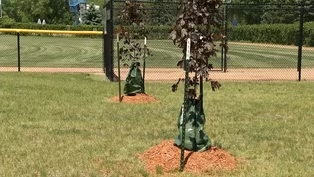
And we received just under $20,000, which we planted 119 new trees that were inch and a half calper or bigger I mean, good sized trees, as well as with that grant we bought watering bags for all the trees, mulch and attachment for a skid loader to help auger in these holes for the trees to be planted in.
- [Mary] Was that for a one-year grant then or a couple of years?
- That was a one year grant that started in 18.
And then we had a timeline to meet by the middle of summer of 19 to have the funds use their expended and then submit all of our paperwork for reimbursement.
But the tree bags are reusable.
So we took them off before winter and the new plantings for this year they're already on as well as the auger we can use for many years to come.
- How did you decide what trees to plant and order for that project?
- After doing this for a few years, pretty familiar with the soils we have in certain parks which definitely makes a difference.
And we also just know what grows well in Marshall whether it's trees that need wind protection or don't mind clay or only like the black loamy soil.
So we kind of base it off of that where we're planning to go and what would fit that area well.
- But you ordered numerous species, I believe, right?
- [Preston] Yep, I think there was eight or nine different species, like locust, Hackberry, Oak, the new Elms, crab Apple, Kentucky coffee tree.
Just to name a few, I think I left out a few.
- [Mary] Well that's A-okay, you went for diversity anyway.
- Yup, yup and other than some Birch, which I didn't mention we did put those in more of a clump but otherwise any of the plantings there were no two same trees planted next to each other.
- You got them in all at one time, I would assume where did you put them or hold them before you could get them all planted?
- At the park maintenance shop.
We just have a big parking lot and the pool wasn't open.
So we just staged them out in the parking lot.
And then we have a watering truck.
So we would just water as needed depending on wind, temp, rain, stuff like that until we could get them in the ground and then once we had them planted, we just watered twice a week and filled those three watering bags.
- [Mary] Did they come in bare root or were they in containers?
- [Preston] Containers.
- Oh, okay.
All right.
Well then you have a little bit more of a time leeway there.
Did you do all of the planting or did you involve community groups in doing the planting too?
- Yeah, the goal was to use mainly volunteers but with last summer being so wet we kind of ran into some timelines with the deadline of the grant and when we could get the trees in the ground from, you know getting a skid loader out on the turf and stuff like that.
So we ended up, I think we had like 16 volunteer hours and then the rest, the park staff did.
- [Mary] Okay.
And you bought some equipment even too to help with all of that planting?
- Yes, that's correct.
We bought a postal auger that went on the skid loader with multiple different auger sizes depending on the tree size and the pot.
And it helped loosen that soil good.
And we went bigger than we needed so that we had some good loose soil to put the pot into when we were done.
- That's what I was gonna ask 'cause sometimes when you have an auger it kind of scarifies the wall and makes it pretty glazed.
Did you have to break that up a little bit when planting?
- Yeah, we did that too in combination of going considerably larger than what we actually needed to.
So we had a good six, seven inches around the outside that was nice and loose.
- Did you add any compost or pit at all when you did the planting?
- We did not do that.
We just put the native soils that were in the area back but we did do like a root stimulator on all of them and then mulch around all of them as well.
We do that for all of our new tree planting.
- [Mary] That's what I was gonna ask if you mulched around those new plantings too.
- Yep, for the first couple of years we'll maintain it and then once we know that year three or four, we'll kind of let the mulch just kind of go away or as it fades or breaks down, we just don't replace it.
- [Mary] What did you use for mulch?
- We get to mulch out of the cities.
It's just a hardwood, stained mulch, you know you get a good two, three years coverage and color out of some of it.
- Did you have to do a lot of reporting back on the grant application to show what you did or did you have to submit pictures and things like that too?
- Yes, we did.
We kept track of all invoices, maps of the different parks that we planted them in our areas and those maps included what species was planted where and then there was an inspector that came out and looked and verified and that they were planted correctly and stuff like that.
And that was all good and okayed.
And then we had to submit all that paperwork back, as well as like our staff spent doing it.
The three species and stuff, like I mentioned, everything was okayed and it was just a great benefit to the community for future years to come.
- [Mary] Did you have pretty good survival rate on all those trees you planted?
- [Preston] Yes.
Out of the 119 trees, I believe we had four that didn't come out of the winter.
So in my opinion, that would be a highly successful rate.
And we will get those replaced yet this summer but maybe wait until fall now and then we'll get those four replaced also.
- [Mary] Did you put tree wraps on the trees at all to protect against the critters?
- [Preston] We don't normally have any problems with that.
I mean, I've seen it very rarely more of our issue is the wind.
So some of them that were susceptible, we did stake.
So the trees behind us do have wraps on, those came from the nursery that way.
We don't apply any wraps to the trees ourselves.
- [Mary] When you do planting, do you plant on private homeowners lots also?
- [Preston] At this time we only plant on city property, city owned property, whether that's in parks or I do have two areas that we've started kind of like a tree farm that we let mainly evergreens grow.
And then when they get, you know, six, eight, 10 feet tall we'll go and spade and move them somewhere else.
In the future, I know some cities are considering doing like a tree replacement program for the Ash and when Emerald ash borer gets to their communities.
So that might be some kind of program that might exist.
I'm just not sure what that would look like at this time.
- [Mary] Well, thank you for all of your help and for all of the great advice in dealing with Emerald ash borer coming down the road.
Thanks so much.
- [Preston] Yeah, thank you.
- [Announcer] Funding for Prairie yard and garden is provided by Heartland Motor Company, providing service to Minnesota and the Dakotas for over 30 years.
In the heart of truck country, Heartland Motor Company, we have your best interest at heart.
Farmer's mutual telephone company and federated telephone cooperative, proud to be powering Acira.
Pioneers in bringing state-of-the-art technology to our rural communities.
Mark and Margaret, Yankel Julene in honor of Shalom Hill farm.
A nonprofit rural education retreat center and a beautiful Prairie setting near Windom, Minnesota.
And by Friends of Prairie Yard and Garden, a community of supporters like you, who engage in the long-term growth of the series.
To become a friend of Prairie yard and garden visit pioneer.org/pyg.
Preview: S34 Ep13 | 29s | Joe Zeleznik explains what emerald ash borer is, how it damages trees and how it spreads. (29s)
Providing Support for PBS.org
Learn Moreabout PBS online sponsorship

- Home and How To

Hit the road in a classic car for a tour through Great Britain with two antiques experts.









Support for PBS provided by:
Prairie Yard & Garden is a local public television program presented by Pioneer PBS
Production sponsorship is provided by ACIRA, Heartland Motor Company, Shalom Hill Farm, Friends of Prairie Yard & Garden, Minnesota Grown and viewers like you.